
 ongames.cc">Final-Fantasy-seem-eternal-cover6aabafbc8b8f7.jpg" alt="Why does Final Fantasy seem eternal?" style="max-width:100%;border-radius:12px;margin-bottom:25px">
Why does Final Fantasy seem eternal?

Some franchises span generations without ever really changing. Others disappear for a few years before returning to the spotlight. And then there’s Final Fantasy. A series that, since 1987, seems to have found a strange way to defy time: constantly changing, taking risks, sometimes dividing opinions, going through more challenging periods… but always coming back. As the franchise approaches its 40th anniversary, boasts more than 30 games to its credit, and ranks among the best-selling franchises of all time, one question deserves to be asked: what allows Final Fantasy to continue to thrive, when so many other great sagas have eventually run out of steam?
► The lack of one single narrative
The first secret of Final Fantasy likely lies in a paradox: unlike many video game franchises, this one has never really needed to tell the same story. When the first installment was released in 1987, it was said that Square was staking part of its future on this project, although this rumor is often disputed. But rather than turning its success into a set formula, the series quickly decided to start all over again.
New characters, new worlds, new combat systems, new storylines: Final Fantasy II, III, IV, V, and VI gradually build a shared identity without ever becoming chapters of a single story. Players therefore don’t need to have completed the previous installments to understand the next one. Each new Final Fantasy serves as a potential gateway into the franchise.
This still rings true today. A player can discover the franchise with Final Fantasy X, VII Remake, XIV, XVI, or even a spin-off, without having to catch up on nearly four decades of history (and that’s quite something). It’s a feature that may seem obvious, but it’s a powerful tool for ensuring a brand’s longevity.
For the curious, or the most hardcore fans, here’s a video that covers all the main games in the franchise in about twenty minutes.
► Reinvent yourself or die
Above all, this lack of narrative continuity allows Final Fantasy to do what many franchises don’t dare: radically change its formula. The series has evolved from turn-based RPGs to Active Time Battle, then to job systems, more dynamic combat, and MMOs with Final Fantasy XI and XIV, before pushing the action even further with Final Fantasy XV and then XVI.
This evolution isn’t limited to gameplay. The worlds themselves are changing dramatically. Medieval fantasy, science fiction, steampunk, urban dystopia, or political narratives… Final Fantasy has never hesitated to change its setting to reflect the ambitions of its time.
This is precisely why the franchise can sometimes seem like it’s no longer the one players once knew. Final Fantasy has no set formula. Its recurring elements, Chocobos, Mogs, Cid, summons, crystals, and certain monsters, all constitute a sort of shared language, a legacy, and Square Enix understands this well: it can preserve them while rebuilding everything around them, thereby revitalizing its formula while still keeping a foot on the ground for players.
This is likely the main reason for its longevity. While some franchises grow stale because they endlessly repeat the same formula, Final Fantasy is willing to take the risk of displeasing part of its audience in an effort to appeal to the next generation.
Final Fantasy XIV, which has just launched on Switch 2, is a prime example of this reinvention. Upon its launch in 2010, it faced numerous issues and failed to live up to Square Enix’s ambitions.
After a period of restructuring, the game world was struck by the fall of Dalamud during the The Seventh Umbral Era event, which served as the justification for shutting down the servers and the disappearance of the original game. Three years later, in 2013, Final Fantasy XIV: A Realm Reborn came out with a new team at the helm, a new engine, and a completely redesigned architecture.
► An Identity that goes beyond the individual entries
This nostalgia strategy also works thanks to a unique feature: Final Fantasy possesses an identity that is much stronger than its continuity.
All it takes is seeing a Chocobo appear, hearing a variation of the victory theme, or recognizing a summon to immediately understand which universe you’re dealing with. Yet none of these elements truly dictates a shared storyline.
This is a fairly rare situation. To put an example, we could mention the Mario franchise, which is embodied almost exclusively by Mario, or The Legend of Zelda, embodied almost exclusively by Link. Final Fantasy, on the other hand, can change its protagonist, time period, gameplay, and even tone while remaining recognizable.
This identity functions almost like a toolbox. Square Enix can select certain familiar elements, transform them, and integrate them into a new context. Players then find something familiar in the midst of a brand-new universe.
► Nostalgia as another driving force
Reinventing oneself doesn’t mean forgetting one’s past. And Final Fantasy is particularly skilled at playing on nostalgia. The franchise now boasts a considerable legacy. Nobuo Uematsu’s music, iconic characters, and historic RPG mechanics have gradually transcended the realm of gaming to become true symbols of Japanese role-playing games.
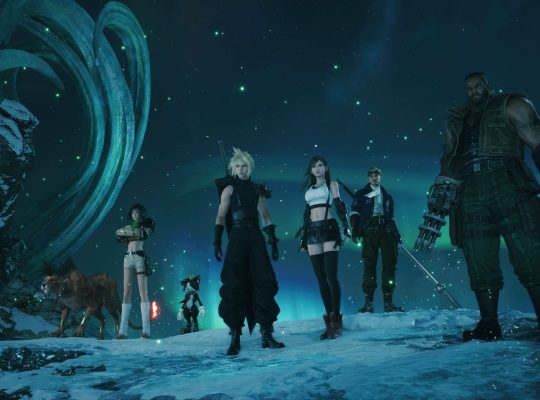
Square Enix has understood this well. Remasters, collections, ports, merchandise, anniversary events, collaborations, and—above all—remakes regularly bring older installments up to date. Final Fantasy VII Remake, Rebirth, and soon Revelation are obviously the most spectacular examples of this, transforming a cult classic into a new experience tailored for a contemporary audience.
Nostalgia acts as a bridge between generations here. Players who discovered Final Fantasy VII in 1997 can return to the new remake trilogy to relive their memories, while players who weren’t even born at the time can discover Cloud, Aerith, or Sephiroth in a version designed for today’s standards. The franchise can thus look to the future without abandoning its past.
► Immortal but not untouchable?
Talking about immortality obviously doesn’t mean the franchise is invincible. Final Fantasy has gone through periods of uncertainty, controversial installments, and changes that have sometimes left part of its audience behind.
The gradual shift from traditional RPGs to action games is probably the best example of this. Some players miss the turn-based system, while others appreciate that the series is striving to evolve. Final Fantasy XVI, for instance, has been seen by some as a tremendous modernization and by others as a step too far away from the franchise’s roots.
And that is the paradox of Final Fantasy: what makes it strong is also its main weakness. With this pace of change, the series runs the risk of losing those who have followed it for years. But if it stays the same, it risks becoming a relic unable to connect with new players. Its history is therefore a series of gambles.
► What might Final Fantasy look like in 10 or 20 years?
That’s ultimately the most interesting question. No one really knows what Final Fantasy XVII, XVIII, or even XXV—if it exists—will be like. Perhaps the main installments will still be action RPGs, or maybe Square Enix will return to a more traditional system… or perhaps technology will enable even more open, immersive worlds, unprecedented interactions, or profoundly different experiences.
Is Final Fantasy, then, immortal? Probably not in the literal sense. No franchise is. But it possesses something far more precious: the ability to die and be reborn with each new installment. One thing seems relatively certain: the next Final Fantasy will likely not be exactly like the one before it. And perhaps that is precisely what allows us to imagine the franchise still going strong in twenty, thirty, or forty years.
Square Enix plans to make Final Fantasy VII much more than just a cult classic: Cloud’s universe is gradually becoming a franchise in its own right, with remakes, spin-offs, prequels, and new projects. The proliferation of FF VII-branded content demonstrates a commitment to keeping this universe alive over the long term, independent of the main saga alone.
The franchise has already explored many genres, and one might almost expect to see a management game, a platformer, or even a roguelike in an upcoming installment. After all, the franchise’s greatest magic may not have been telling fantastical stories. It’s been its ability, since 1987, to ensure that every generation has its own Final Fantasy.